
When the owner of The Blind Pig – a well regarded restaurant concept with locations in Santa Margarita and Yorba Linda – approached Hendy with a new brief, the ask was both clear and ambitious: build an Italian restaurant concept that could stand entirely on it’s own.
A space designed with intention- modern but playful, bold but livable, immersive by design. The challenge was translating that vision into a physical environment that could hold multiple identities at once: high-energy at lunch, intimate at dinner, and memorable enough to become a destination in its own right.
The result: Monaco Italian Kitchen. A 3,524 square-foot dining environment in Irvine that expanded Hendy’s hospitality design thinking in equal measure architecturally and operationally.
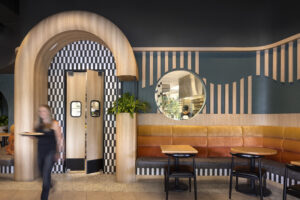
No Straight Lines
Visioning sessions uncovered a taste for funky light fixtures, saturated color, and organic shapes, which evolved into something refined and experiential.
The jumping off point for the Hendy team? A space grounded in evocative architecture.
One of the most deliberate structural decisions on Monaco was the near-total elimination of straight walls. Curves run throughout the space – in the architectural envelope, in the millwork, in the custom banquette nooks – creating a continuous sense of movement that keeps the eye engaged and the room feeling larger than its footprint.
Monaco doesn’t ask you to notice where the inside ends and the outside begins. The patio continues the material palette and design intention of the dining room, creating a single uninterrupted environment that opens to the sky.
The decision to lean into experiential design wasn’t solely visually driven. Organic geometry softens acoustics, guides circulation naturally, and prevents the fatigue that rigid grid layouts often produce in high-volume dining environments. At Monaco, the curves do real work.
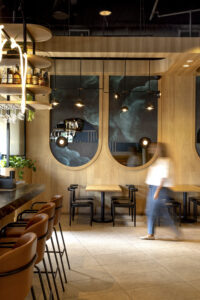
The Bar As the Anchor
Once spatial geometry was established, the team turned to the room’s gravitational center, the bar. A large-scale hanging installation anchors it from above – integrating lighting and bottle storage into a single dramatic element that commands the space without blocking sightlines. It’s a detail that solves a practical problem (display and illumination) while becoming the visual statement guests remember.
Playful custom murals (one above the bar, one on the ceiling of the entry and host area) both commissioned from a muralist brought in specifically for the project – extend the design language vertically, pulling the eye upward and reinforcing the sense of a fully considered environment.
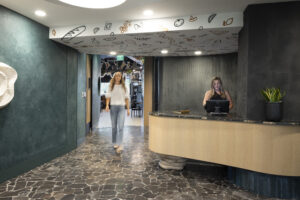
Materials Built to Last
Restaurant interiors face a wear standard that most commercial spaces don’t. At Monaco, material selection was driven by durability as much as beauty – white oak to warm structural surfaces, natural stone and aggregate concrete on the floors, terracotta and graphic black-and-white tile on the patio. Metal elements and soft banquette fabrics provide textural contrast without competing.
Lush greenery threads through the interior, softening the high-contrast palette and keeping the environment feeling warm. The plants are a grounding element, and one that required coordination with the overall spatial layout to avoid feeling incidental.
The restrooms, a space often delegated as an afterthought, serve a continuation of the design experience with dark ceilings, custom tile and warm lighting over the vanity.
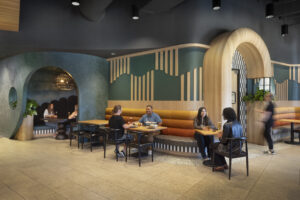
What the Space Delivers
Monaco opened with the capacity to serve lunch, dinner, and happy hour in a single environment that shifts energy by time of day through lighting alone. The private dining nooks, give guests the feeling of a reserved corner within an open, social room.
The final space reflects what Hendy’s design process is built to deliver: an environment where every material, structural decision, and spatial detail serves the experience – and where the architecture itself becomes part of what guests come back for.